
_edited.png)
The Shallow Breath Trap

Updated: Mar 27
Modern humans track every KPI, optimize every workflow, and measure almost every system's performance. Yet, most professionals are overlooking one fundamental system they own: their biomechanics of breathing.
If you feel a lack of focus, "tight" in the shoulders or find your focus wavering by 3:00 PM, you might not be lacking caffeine, sometimes we are trapped in a physiological state of emergency. Dont take my word for it and take the test below yourself!
The Biomechanics of the "Stress Breath"
When you’re under pressure, your body defaults to chest breathing, which is neurologically linked to mouth breathing. It signals the Sympathetic Nervous System the better known "fight or flight" mechanism, which is why the body uses the chest in order to mobilize more breathing capacity.
From a biomechanical standpoint, this is highly inefficient. Shallow chest breathing relies on auxiliary respiratory muscles going up to our neck and shoulder complex. These muscles weren't designed to do the heavy lifting of thousands of breaths a day. Hence: Neck Pain, Shoulder Pain. Ouchie. Using them sends a constant "alarm" signal to the brain, keeping you in a state of low-grade anxiety.
More Than Just a "Belly": The Diaphragm Complex
I often hear the term "belly breathing,". To truly optimize your performance, you must understand Diaphragmatic Breathing.
The diaphragm is an incredibly powerful muscle-tendon complex shaped like a dome that does its job continously 15,000, 20,000, maybe 30,000 times a day - depending on your breathing frequency. This is amazing! Crucially, its attachments wrap around the spine and connect deep within your core and back.
So when you breathe diaphragmatically, you aren’t just "pushing your belly out". You are actually engaging the back, too! True diaphragmatic breathing involves the expansion of the ribs, the belly, and even the lower back.
The Hi-Lo Test: A Quick Self-Audit
Are you stuck in a shallow chest breathing pattern without knowing it?
Use the easy Hi-Lo Test to find out:
Place one hand on your upper chest and the other on your belly, just above the navel.
Take a deep, natural breath through your nose.
The Result: If the hand on your chest moves first or significantly more than the hand on your belly, you are a "Hi" (chest) breather. In a healthy "Lo" breath, the bottom hand moves outward while the top hand remains relatively still.
Why You Should Focus on Your Diaphragm: 3 Major Benefits
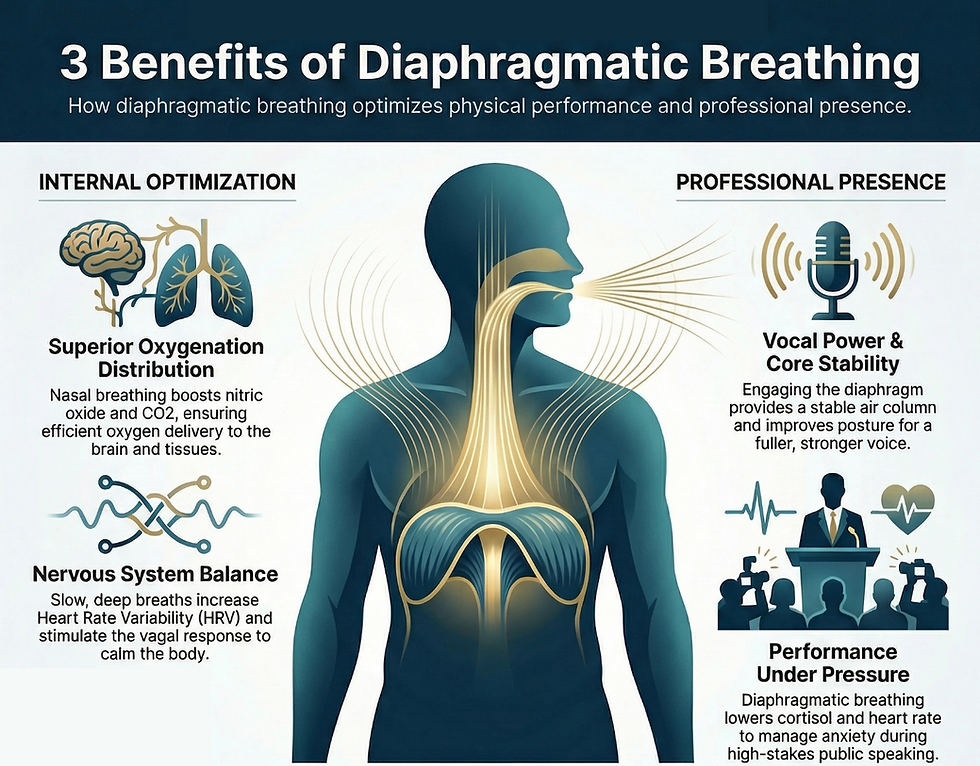
Shifting your focus to the diaphragm provides an immediate "biological upgrade" for the busy professional and everybody else. The major benefits (yes, there are far more) for professionals are:
1. Nervous System Balance: Diaphragmatic breathing (specifically through the nose) stimulates the vagus nerve, which activates the Parasympathetic Nervous System. This is the "rest and digest" or "flow state" mode that allows for calm, analytical thinking under pressure. This directly affects your heart and blood pressure positively, when vessels are less constricted due to better recruitment of the "calming part" of the nervous system.
2. Superior Oxygen Distribution: Shallow breaths only fill the top portion of the lungs, where blood flow is lowest. Deep, diaphragmatic breaths reach the lower bronchioles and alveoli, which maximizes gas exchange, increase your CO2 (which is essential for releasing oxygen from your blood into your tissues and mitochondria) and optimize blood pH. This ensures your brain receives better oxygen levels for high-level decision-making.
3. Vocal Power: Did you ever feel your voice is leaving you after hours of presenting in meetings or during public speaking? Diaphragmatic breathing provides a stable column of air that acts as the primary power source for your voice instead of using up the tiny, delicate muscles in your throat. Additionally, it transmits a fuller, better sound from your voice to your audience, because the resonance body is bigger. It is like you switched from a small violin to a contrabass! Finally, it calms your body and if you ever experienced anxiety or nervousness, while you talk in front of others, you should start trying this out for yourself!
Your Next Step
Try this:
Close your mouth, breathe exclusively through your nose, and focus on expanding your lower ribs into your chair so that you actually feel your back expanding into the chair.
Additionally, before you go to sleep take one hand and put it on your stomach and try to lift your hand up first. Those are two easy and great exercises for better breath awareness.
Literature
Bayrak et al., Effects of Nasal and Oral Breathing on Respiratory Muscle and Brain Function: A Review, 2015. Accessed: March 26th, 2026. Source: Meta-analysis of https://pmc.ncbi.nlm.nih.gov/articles/PMC12047190/


Comments